

Learn How to Assess Posture, Identify Dysfunction & Prescribe Exercises That Restore Movement
Take your client assessments to the next level.The Advanced Posture Analysis & Corrective Exercises Workshop gives personal trainers the practical knowledge and confidence to conduct comprehensive static and dynamic postural assessments, identify common postural dysfunctions and prescribe targeted exercises designed to improve movement, restore function and help clients feel and move better.This hands-on workshop takes you beyond simply identifying that a client has "poor posture." You'll learn how to analyse why a postural dysfunction may be occurring, understand the relationship between muscle length and tension, assess joint mobility and stability, and use this information to develop appropriate exercise strategies.
📌 Course Details
✅ Fully Accredited (AusActive CPDs) – 6 CPDs
🔗 Combines Posture Analysis & Corrective Exercises
🏋️ Practical + Online-Based Learning
👥 Designed Specifically for Personal Trainers to use with their PT Clients
Blended Delivery - Online & Practical
📅 When: Practical Day - Saturday, October 17th, 2026
⏰ Time: 3pm - 6pm
💰 Fee: $199.00
💻 Please note: Pre-practical online lectures to view prior to the practical date (approx. 3 hours)
Fully Online - Coming Soon!


STOP GUESSING. START ASSESSING.
Posture can tell you a lot about how your client moves.
But identifying a postural deviation is only the beginning.
The real skill is understanding what may be contributing to it and what you can do about it.
This workshop takes you through a systematic approach to posture assessment, including:
-
What posture is and what influences it
-
Muscle length-tension relationships
-
Myofascial lines and their relationship with posture
-
Joint mobility and stability
-
Identifying short and tight muscles
-
Understanding common postural dysfunctions
-
Static and dynamic assessment techniques
-
Exercise selection and corrective strategies
-
Mobility and stretching techniques
-
Integrated corrective exercises
You'll leave with practical assessment and exercise prescription skills that you can immediately apply with your own clients.
3. COMMON POSTURAL DYSFUNCTIONS
Learn how to identify and understand a range of common postural conditions and movement deviations.
The workshop covers:
-
Anterior pelvic tilt
-
Flat feet
-
Thoracic kyphosis
-
Lumbar lordosis
-
Scoliosis
-
Rounded shoulders
-
Elevated shoulders
-
Internally rotated shoulders
-
Winged scapula
-
Flat-back posture
-
Sway-back posture
-
Knocked knees
Rather than simply identifying the condition, you'll learn to look at the muscles, joints and movement patterns that may be contributing to the presentation

WHAT YOU'LL LEARN
1. UNDERSTANDING POSTURE
Build a strong foundation by understanding what posture actually is and the factors that contribute to efficient and inefficient movement.
You'll explore:
-
What is posture?
-
Examples of ideal posture
-
Factors that influence posture
-
Length-tension relationships between muscles at joints
-
How muscular imbalances can influence movement
-
The relationship between posture, mobility and stability
2. THE BIG THREE MOBILITY AREAS
ANKLES • HIPS • THORACIC SPINE
Learn why these three areas are so important when assessing movement and posture.
You'll investigate how limitations in:
Ankle mobility
can influence lower-limb alignment and movement.
Hip mobility
can affect pelvic position, lower-back movement and lower-limb mechanics.
Thoracic spine mobility
can influence spinal position, shoulder movement and upper-body posture.
You'll learn practical ways to assess and improve mobility in these key areas.
CORRECTIVE EXERCISE PRESCRIPTION
Once you've identified the problem, what do you do about it?
This is where the practical application begins.
You'll learn how to take your assessment findings and use them to help develop an appropriate exercise strategy.
The practical component includes:
FOAM ROLLER TECHNIQUES
Learn practical foam roller techniques that can be incorporated into your client's warm-up, mobility and corrective exercise strategies.
MOBILISERS & DYNAMIC STRETCHES
Learn practical mobility exercises and dynamic stretching techniques designed to help address movement restrictions.
INTEGRATED & CORRECTIVE EXERCISES
Learn how to integrate mobility, stability and strength exercises into your client's training program.
The goal is not simply to stretch a "tight" muscle.
It's about understanding the assessment and selecting exercises that help your client move more effectively.
Check out this video!
YTWL is one of the exercises taught in this workshop and one of the most comprehensive posture corrective techniques. Improves mobility in the thoracic spine, activates Glutes, opens the chest up, pulls the shoulder blade back

CONTINUE YOUR PROFESSIONAL DEVELOPMENT
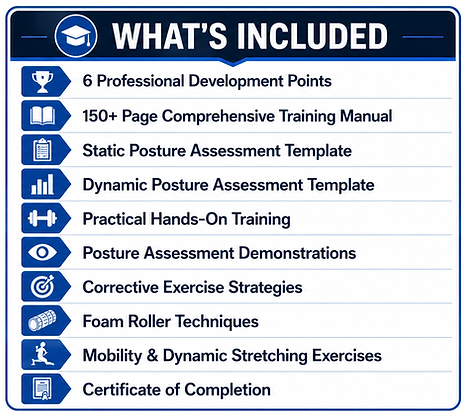
Earn professional development points while developing practical skills that can be immediately applied to your personal training business.You'll leave with more than just a certificate.You'll have a structured assessment process, practical exercise ideas and resources that you can continue using with your clients.